I’ve based this recipe on Ottolengh’s fab spicy mushroom lasagne from his ‘Flavour‘ recipe book, making the necessary changes so that it’s suitable for vegans, as well as gluten and dairy free.
This recipe is true to Ottolenghi’s exotic cooking style; definitely not a whip-it-up-quickly meal. The layer upon layer of a lasagne translates to several ‘meanwhiles’ in the method section, but don’t let that put you off. This is truly a recipe to enjoy, a lesson in being present with all the processes in play, from chopping to blending, roasting, soaking. You name it, it’s happening here! And this is why it’s such a winning recipe, all these delicious layers upon layers. I’ve numbered the steps, which wasn’t in the original, but I think it might’ve helped me along.
Luckily a lot can be cooked in advance – always good news. An asterisk marks the point you can prepare it the day before refrigerating overnight.
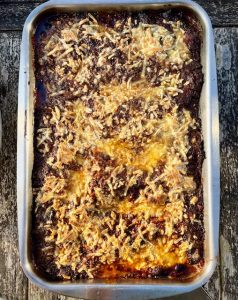
Instead of the original Ottolenghi double cream, parmesan and pecorino I’ve used oat cream, vegan cheddar and a gluten & egg-free lasagne like Freee rice lasagne, easy peasy.
An aside: many cheeses like parmesan and pecorino (in the original recipe) use animal rennet – eg. from sheep’s stomach – in the cheese-making process. There are, however, vegetarian rennets readily available so check your cheese labels, or stick to the vegan cheddar-lookalike I’ve used here. Perhaps where you live there are also vegan parmesan-type cheeses? (also perhaps where I live, but they’ve eluded me 🙂 Do share if you’ve found them).
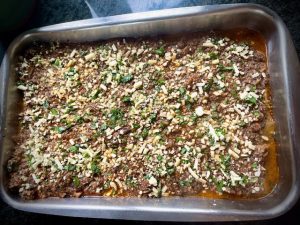
Ingredients:
For 6 people
Equipment: large cooking pan, large and small bowls, sieve, measuring jug, food processor (or very sharp chopping knife… and some willing helpers!), rimmed oven baking tray, rectangular baking dish 30cm x 20 cm, and probaby a few other bits I’ve forgotten, but I’ve listed the stand-outs for me
800g chestnut mushrooms halved
500g oyster mushrooms, roughly chopped
60g dried porcini mushrooms
30g dried wild mushrooms
130ml olive oil
chilli, 2 dried, roughly chopped. If you like extra hot, leave in the seeds
1 red onion, peeled, quartered
5 garlic cloves, chopped or grated
500 ml hot veg stock
1 medium carrot, rough chunks
2 tomatoes c 250g, quartered
80g tomato paste
130ml oat cream
160g Violife grated vegan cheddar cheese, or another vegan ‘hard cheese’ equivalent (or two different ones)
5g basil leaves, finely chopped
10g parsely leaves, finely chopped
250g Freee Rice lasagna, or a vegan lasagna of your choice
sea salt and ground pepper to taste
Method
1) The oven: Preheat to 230 degrees C fan oven (250 conventional oven; 446 Fahrenheit).
2) The fresh mushrooms: Either chop by hand or put the oyster and chestnut mushrooms into a food processor in batches, and pulse till finely chopped. Add to a large bowl with 4 tbsp of the oil and 1 tsp salt, mix, then spread on a large parchment-lined rimmed baking tray so that it’s an even layer.
Bake for 30 minutes, stirring a few times so it doesn’t catch. The result will look considerably less as a lot of the water has been baked away. All good!
Remove and put aside, then turn down the oven to 200C (c. 390F) and sit with a cuppa whilst you read on…
3) Meanwhile, the dried mushrooms: Combine in a medium bowl both sorts with the chilli and your hot veg stock. Let soak for half an hour then strain the liquid, squeezing as much as possible from the mushrooms so you end up with c340 ml (just top up with water if you have less, or squeeze those ‘shrooms a bit more).
Set aside the liquid. Chop the rehydrated mushrooms and finely chop the chilli, and also set aside.
4) Now to the onion, carrot and garlic! Chop them in the food processor – or by hand – then put into a pan with 60ml of your olive oil and fry for 10 mins, stirring till soft and golden.
5) The tomatoes: Pulse them in the food processor till finely chopped and add, together with the 80g tomato paste, to your fried onion/carrot pan.
Salt and pepper this to your taste and cook for about 10 mins, stirring now and again.
6) Add the chopped chilli and all the mushrooms – those roasted ones, the rehydrated ones – to your carrot/onion/tomato pan and cook for 10 mins.
7) The ‘ragu’ (or ragout, whatever you prefer), is almost there, hooray! Stir in the reserved stock and 500ml water. Simmer for 20-30 mins, adding more water if your meaty-looking ragu looks like it’s getting too dry.
Stir in 100 ml oat cream and simmer another few minutes (just to ensure it’s well mixed). Remove from the heat, and sit back, take a slow breath and be happy that you have just created a delicious meaty-textured mushroom ragout which you will now (or tomorrow) layer into a lasagne.
* At this point you can pop it in the fridge, covered, and continue the following day.
8) The cheese: Mix the grated vegan cheddar (and/or parmesan-ish vegan cheese) and the chopped basil and parsley in a bowl and prepare to start assembling your layers.
9) Layering your lasagne:
Spread approx 1/3* the mushroom ragu in the bottom of a 30cm x 20cm rectangular dish.
Top with approx 1/3 of cheese mixture, then top this with your lasagne sheets, breaking it into bits to fit corners.
*Ottolenghi states 1/5, not 1/3. I’ve made this three times now, and so far 1/3 works best for me.
Repeat until you finish with a final layer of mushroom sauce and vegan grated cheese.
10) drizzle 1 tbsp oat cream and 1 tbsp oil and cover with foil or baking paper.
Bake approx 15 mins before removing the foil/paper.
Increase your oven temp to 220 C fan (240C conventional; 425 F) and bake another 10 minutes, turning your rectangular dish around so everything is evenly browned.
11) Set aside to cool, drizzle over the remaining cream and oil and sprinkle with parsley.
12) Bravo! You’re ready to serve.
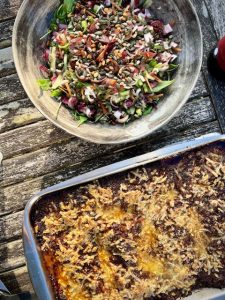
And after all this, just a leafy green salad with chopped herbs and any other salady bits you have at hand will be perfect 😉
A nerdy note to share with practitioners/foodie peeps trying a low FODMAP diet*
(For all other readers, you’ve been warned!):
I was working with three SIBO clients, all keen on the low FODMAP* diet, at the time I was playing with this vegan version. I decided to try turning this recipe into a low FODMAP (why??? Most mushrooms, tomato, tomato puree, garlic, onion, chilli…are all high FODMAP foods).
Yes…. well, there was a wild-eyed glimmer of hope when I saw that oyster mushrooms are low in FODMAPS. Tomatoes, too, in small amounts, ie. 45g of chopped and 25g tomato paste, according to the Monash FODMAP guide
So I only used oyster mushrooms and a smaller amount of tomato and paste. I replaced the onion, high FODMAP, with the chopped green part of a leek (low).
No chilli as it’s high FODMAP, hey ho, so the ‘spicy’ component of the recipe vanished. However, any of my clients with SIBO related gut distress will totally go along with this. I made more of the basil by making an olive oil, basil, pinenut type pesto (pine nuts are low FODMAP nuts).
Aged dairy cheese is a lower FODMAP food, but sticking to the vegan option you can use something like Violife’s grated ‘mature’ ,as I’ve done in the above vegan recipe, as it’s free from dairy, preservatives, lactose, gluten, nuts and soya.
For those who have stuck to the end of this read, huge congratulations! This low FODMAP version is indeed a very different meal to the one I’m posting today, but it was very tasty plus a good option for anyone who loves mushrooms and wants to add to their low FODMAP vegan repertoire.
*Low FODMAP diet is a short-term diet restricting certain poorly absorbed carbs which can ferment in the colon and cause IBS-ish discomfort in some people. Some clients do very well on it, as it can calm down inflammation and give the GI tract a break whilst waiting for the results of tests, or trialling some supplements. It should, however, only be a short-term diet as it excludes too many health-giving foods.
Btw FODMAP is the acronym for the carbs which are too many and complicated to write in the swing of a recipe, but FYI it stands for: fermentable oligosaccharides, disaccharides, monosaccharides and polyols. FODMAP, much easier, right?