Lentil bolognese

Over the years I’ve tried variations on this lentil bolognese theme and it’s now grown into a delicious concoction of tried and tested recipes.  Packed with vegetables it cooks into a deep, rich-flavoured stewy-type sauce.
I often use puy lentils as they hold their form well, but brown lentils also work although they can become mushy if overcooked.  Best to do a taste test after c 20 mins to see if their texture is to your liking.

Last weekend I thought this recipe might work with a Christmas vibe, so I added cranberries and chestnuts to the base veg mix.
I probably added them to the pan too soon!  Most of the fab sour-fruitiness of the cranberries was cooked away, plus I couldn’t really taste the chestnuts.  On my second attempt the other night, I stirred in a handful of fresh cranberries for the last 8 mins of cooking.  Gave the whole dish a very festive look.

So, if you feel like a change over the silly season, a rice or pasta dish instead of roasted everything, then give it a try.  Perhaps even a dollop of cranberry sauce on top!

Some lentil advice:

I always soak lentils despite packet instructions, or the powers that think-they-be, claiming it’s not necessary as they’re small.

Small or not, they belong to the  pulse/bean/legume family, and this family contains oligosaccharydes, a type of carbohydrate (it’s the ‘O’ in FODMAP* ….ohhh!).
Our gut microbes break down these carbs, and in doing so, produce beneficial compounds but also gases which can cause bloating/wind/discomfort for some.
Soaking overnight will reduce the amount of  ‘Os’  and make them easier to digest.  And this soaking will also reduce the amount of phytic acid that we mainly find in the outer layer of the pulse, something that can interfere with enzymes that help us digest.  Phytic acid also binds to minerals in our food, and can prevent their absorption.  We need minerals!  Our calcium, magnesium, iron, zinc, potassium….so there’s only gains to be had by soaking those lentils!
Ok, enough lentil chat.

Ingredients

serves 4, with rice or pasta

160 g soaked lentils. I used puy but try others; be aware of cooking time as some turn mushy
3 tbsp olive oil
1 onion, finely chopped
1/2 leek, green part, chopped
1 stick celery, chopped
1 large carrot, chopped
3 large or 4 small garlic cloves, pressed or finely chopped
1 can chopped tomatoes
2-3 tbsp Dorsetshire sauce (vegan type of Worcestershire sauce with no anchovies; Bonsan and The Condiment company are two examples of other vegan Worcestershire sauces)
1/2 litre vegetable broth plus half to one cup more added near the end of cooking IF you want your bolognese more liquid
leaves of 4 sprigs of fresh thyme
chopped fresh parsley for decoration

Method

Soak the lentils the night before, discard the water, rinse and sieve then you’re ready to start.

Add olive oil to a deep pan on a medium heat, and cook the onions until transparent.  Stir in the chopped leek and cook until slightly softened.  Add the celery, carrots, garlic and gently cook for about 15 minutes.  Then come the lentils, can of chopped tomatoes, tomato puree, veg stock and the thyme leaves.

Simmer on a low to medium heat for about 40 minutes until the sauce has thickened and the lentils are cooked to your liking (I usually do a taste test around 30-35 minutes or earlier, depending on the type of lentil).

For a Christmas flavour, add cranberries for the last 8 minutes of cooking and enjoy with brown or mixed rice, or any pasta your digestion loves 🙂


*FODMAP  stands for fermentable oligosaccharides, disaccharides, monosaccharides and polyols, a group of  short chain fermentable carbs which can cause distressing IBS-type symptoms.  The low FODMAP diet aims to exclude/reduce the amount of these in your daily foods and then try a slow introduction of each type to see which may be your symptom trigger.  This diet is only meant to be short-term as it’s very restrictive.
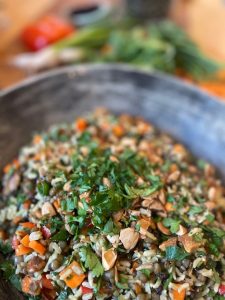
Glenys’ vegan oriental rice

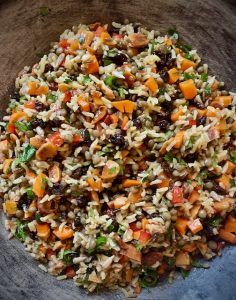
Sometimes we need easy and straight-forward recipes especially if juggling work and life.  This rice dish has been in my heart and on our family table for many years.  It’s one of several a dear Sydney friend, Glenys, shared a long time ago, written in her lovely script in my now raggedy falling-apart recipe book.  Everytime I make a Glenys dish it’s such a mindful meander down memory lane I want to call her instantly, then I realize it’s way past midnight in Sydney.


Growing up, I was never a fan of rice salads.  Usually very white, sometimes gooey, and not enough going on in them to win me over.   The combo here of snibbled crispy veg with nutty and/or seedy crunch plus the tamari-lemony garlic works a treat.
I can’t say I’ve found any other rice salads I love as much apart from one with lentils, so if you have a secret scrummy rice salad please share with me anywhere you want – text, email or even snail mail (how I’ve loved these past weeks of hand-written post! Thank you to all snail mailers, let’s keep it going xxx)

This salad could be part of a shared feast, or enjoy with supper or lunch alongside any protein you love.
Do tweak the amount of tamari or garlic or lemon so it suits your tastebuds before you lavish it over your finished creation x

Ingredients

For 4

250g  brown or mixed rice (eg.wild, red & brown basmati)
5  spring onions (or 3 large ones), finely chopped
1 red & 1 green pepper, finely chopped
2 smallish carrots, finely chopped
3 tbsp sunflower and pumpkin seeds
150 g almonds, toasted and roughly chopped (last time I used some left over delicious Spanish Marcona almonds and didn’t roast);   1 tbsp to decorate at the end
150g cup currants (soak if you’ve had them stored far too long, overnight or at least 6 hours)
One generous handful, or 120g each, of chopped coriander and parsley

Dressing:

120g cup olive oil or avocado oil
3-4 tbsp gf tamari sauce (start with 3 then taste test and adjust if necessary)
3 tbsp lemon juice (ditto)
2 cloves garlic
sea salt & freshly ground pepper to taste

Method

Cook the rice and let cool.  Meanwhile toast the skinned almonds until golden brown, cool and chop roughly.  Mix all the finely chopped vegetables and herbs with the currants, nuts and/or seeds, and the cooled rice.
Pour over dressing and mix; top with tbsp chopped almonds.
Can’t get much easier, right?

Vegan savoury strudel, gf and df

This recipe was inspired by Elke’s Austrian take on a Greek spanakopita (spinach pie).  Instead of the usual triangle slices of a traditional spanakopita, she opted for the strudel “log” shape, and added loads more delicious spinach than one normally finds in these pies.
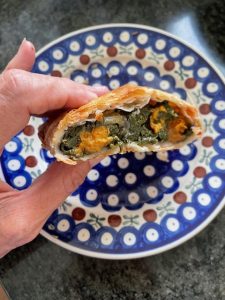
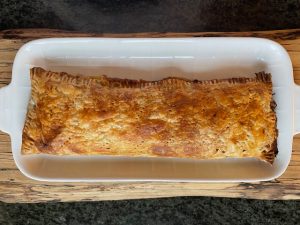
I’ve tweaked the recipe yet again by adding more vegetables to the spinach.  So it’s no longer a spanakopita but a roasted sweet potato, spinach and leek ‘strudel’!  And with a gluten-free puff pastry and dairy-free fetta; a vegan version to see how it works.
Worked a treat!

The store-bought ‘Jus-roll’ gluten-free puff pastry makes it all so very easy and quick.  And Violife’s vegan Greek fetta is delicious and a great option for anyone going vegan, or with a casein (dairy protein) or lactose intolerance.
You can steam the sweet potato cubes, definitely the healthy option, but as I was roasting a lunch the day before I decided to add the sweet potato cubes to the oven; also the pine nuts right at the end.  Less work the following day when I was playing with this recipe.

Ingredients:

For six slices

1 packet Jus-roll gluten free puff pastry (or regular Jus-roll puff; or filo.. shortcrust, whatever you like)
400g packet spinach, roughly chopped
green part of one leek, finely sliced
3 cloves garlic, squeezed (two at the start, one added near the end)
1 large sweet potato, about 250g, cubed, then either roasted or steamed before you start your log
dollop of olive oil for a light fry and to lightly brush onto the log before baking
80g toasted pine nuts
100g Violife ‘Greek white’ (or non vegan, regular Greek fetta)

Method:

If you haven’t roasted your pine nuts, nor your cubed sweet potato, do this first.  When done put aside where no one will be tempted to have a nibble.

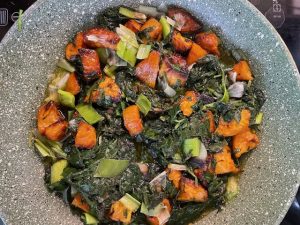
For the filling, pour a couple of tablespoons of olive oil in a pan on a medium heat then add the sliced leek and 2 of the pressed garlic.  Gently fry until the leek’s transparent.
Toss in the roughly chopped spinach and wilt.  Hover near the pan otherwise your delicious leafy spinach pile will vanish to an overwilted green sludge.  The same goes for the pine nuts, keep close, for if you leave the kitchen even for a moment they are bound to burn.  Hover.  Keep watch.

Add the roasted/steamed sweet potato cubes to the pan of spinach to warm through, then that last garlic clove.  Stir in the roasted pine nuts.

Wait for everything to cool before adding the crumbled fetta.

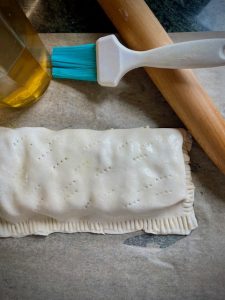
With ‘Jus-roll’ you can literally unravel it from the box and start filling it with your cooked veg, so easy.
However, if it’s too thick for your taste roll it thinner and larger.  Whatever you decide, ensure you have parchment underneath it (the paper it comes wrapped in its box), so you can easily lift the filled roll onto the oven tray.

Spoon the filling along the long side of half the pastry, leaving a clear 2-3 cms edge all around so you can seal it without the filling oozing out.  To make your log just fold over the pastry and, with water-wet fingers, press the edges closed then go over them with a fork to create a neater, tighter finish.  Brush with oil and prick the pastry, to stop a gap forming inside as it cooks.

Bake in a moderate fan oven, about 180 C degrees (c350 F), until light golden brown, approx 30 – 45 mins (depending on everyone’s unique oven.  Like us, they have personalities and might decide to take longer to colour your strudel).

Slice and serve with a leafy colourful salad, or as part of a delicious summer garden spread.

Kali oreksi! Bon appetit x


Cypriot grain salad

This is a delicious salad a friend brought to the table on my recent trip back to Sydney when a gaggle of us got together for a catch up feast.  It’s inspired by the ‘Hellenic Republic’ grain salad recipe by Melbourne chef George Dimitrios Calombaris.


Instead of freekah (cracked wheat) I used quinoa only because I didn’t have freekah in my pantry.  It’s a good gluten-free option although be aware that pseudo grains like quinoa can be a problem for grain-, or gluten-sensitive peeps.
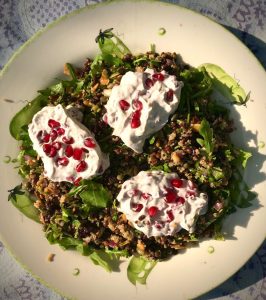
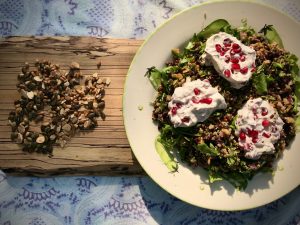
I also used dairy-free coconut yoghurt as that’s what I had at hand – and with that the salad morphed into a vegan recipe!  And even though df yoghurt doesn’t sound very Hellenic it was absolutely delicious with the cumin and pomegranate swirled in it.  Also I snuck in some rocket because I love leafy greens and it’s such an easy way to get more into your daily diet.
All in all, this is a well-rounded dish with all the macronutrients you need, so enjoy it on its own, or alongside other dishes for a feast.  Last week we ate it as a side with falafel, very yummy.


Ingredients

(serves 4)

100g red and white quinoa (or freekah)
100g Puy lentils
1 bunch coriander, chopped
1 bunch parsely, chopped
handful rocket or any salad leaves you like
1 small red onion, finely chopped
2 tbsp (c 30g) toasted pine nuts
2 tbsp toasted flaked almonds
2 tbsp toasted pumpkin seeds
2-3 tbsp small capers
70g currants
3 tbsp extra virgin olive oil
1 lemon, juiced
100g pomegranate seeds (or a whole pomegranate)
100g Greek yoghurt or dairy free alternative
1 heaped tsp ground cumin

Method

Boil the Puy lentils and quinoa separately in water until cooked to your liking.  Drain and cool.
In a bowl, add these to the chopped herbs, toasted nuts and seeds, capers, currants, lemon juice and olive oil.  Mix well and then stir in the rocket or salad leaves.
Add the ground cumin and pomegranate to the yoghurt and dollop on top of the salad.
Easy, quick and very scrummy!